
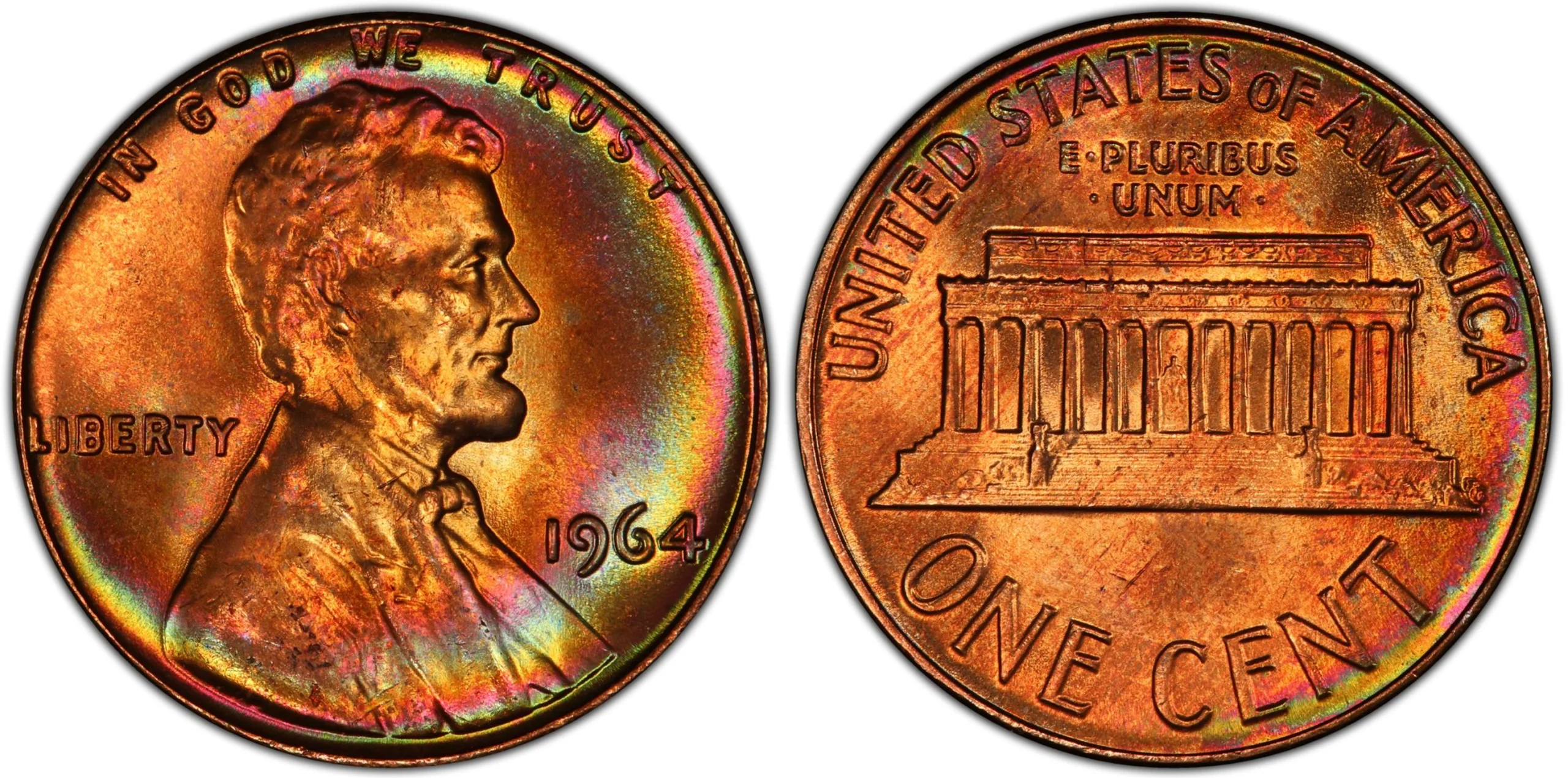
The 1964 penny value at auctions up to $9,000 and more for Red high mint issues. You should have certifications for your rare items.
1964 Lincoln Penny Specifications
| Year | 1964 |
| Diameter | 19.05 mm |
| Weight | 3.11 g |
| Edge | Plain |
| Composition | Mostly Copper |
| Philadelphia | No Mint Mark |
| Denver | D Mint Mark |
The auction for D pennies reflects a distinct pattern of condition scarcity. A pristine D cent in MS-67 Red condition remains a true trophy.
Penny Auction Records by Mint Mark
| Record Price | Type | Mint |
| $7,931 | MS-67 Red | Philadelphia |
| $4,025 | MS-67 | Denver |
| $2,588 | MS-63 Red-Brown | Philadelphia |
| $2,040 | MS-64 Red-Brown | Denver |
The market for regular business-strike 1964 pennies operates on a steep valuation curve. While billions of these coins entered public circulation, only a microscopic fraction survived without contact marks or environmental stains.
Philadelphia Penny
Numismatists focus their competitive energy on the tiny group of coins that escaped the rough handling of heavy canvas mint bags and automated sorting machinery. These rare survivors carry high numismatic grades and draw intense bidding wars at major coin auctions.
Denver Penny
The Denver Mint also contributed heavily to the massive mintage totals of 1964, as it turned out over 3.7 billion cents. Despite this even larger production total, high-grade examples from Denver present an acute challenge to numismatists.
1964 SMS Penny
The United States Mint did not officially announce or sell SMS sets in 1964. Official Special Mint Sets only entered the public market from 1965 through 1967 as a temporary replacement for traditional proof sets.
Yet, a tiny handful of 1964-dated cents, nickels, dimes, quarters, and half dollars exist with identical SMS characteristics. Most numismatic scholars believe that the mint created these rare, experimental pieces as prototypes or test strikes for the upcoming 1965 change in coin production.
An SMS penny exhibits an elegant, non-reflective satin finish across its surfaces. The fields lack the brilliant mirror sheen of a standard proof coin, yet they do not display the typical flow lines of a business strike.
According to information from coin-identifier.com, the rims of an SMS cent are remarkably:
- Sharp
- Square
- Prominent
SMS Record Sale
| Price | Type | Platform |
| $19,200 | SP-67 Red | Heritage Auctions |
| $9,000 | SP-65 Red-Brown | Heritage Auctions |
1964 SMS pennies generate immense excitement whenever they appear on the public market, because of their extreme rarity.
This multi-thousand-dollar result did not happen in a vacuum. A look at past auction data reveals a steady, long-term investment path. Decades ago, these coins traded for significantly lower sums because the wider numismatic community did not yet fully recognize or attribute the 1964 SMS status.
Why Certain 1964 Pennies Explode in Price
To navigate this high-stakes market successfully, you must comprehend the specific physical attributes that drive these massive price spikes. Third-party grading services like PCGS and NGC apply incredibly rigorous standards before they assign a record-breaking grade to any 1964 Lincoln cent.
Color Varieties
Copper is a highly reactive metal that darkens and tarnishes when it encounters oxygen, moisture, and human touch. Grading services divide copper cents into three distinct color classifications based on the amount of original mint luster that remains on the surfaces, because of this chemical vulnerability:
Red – the coin must retain 95 % or more of its original, vibrant mint orange-red color.
Red-Brown – the surfaces show a mixture of original luster and brown oxidation, with red tones covering between 5 % and 95 % of the coin.
Brown – the coin has lost nearly all its original color, and brown tones cover more than 95 % of the surfaces.
The Role of Population Reports from PCGS and NGC
Numismatic value depends heavily on the economic law of supply and demand. In the coin market, supply is tracked through official Population Reports maintained by PCGS and NGC.
These database registries log every single coin that receives a professional grade. The growth or stability of these population figures dictates price movements.
When a coin has a population of just two or three known examples at the MS-67+ or SP-67 level, a state of extreme scarcity exists. Wealthy collectors who compete for the top spot in online registry sets will bid aggressively to secure that rare piece.
If an old hoard of original 1964 mint rolls comes to light, and collectors submit dozens of pristine coins to PCGS, the population census will expand. A single addition to an elite grade tier can weaken market stability and dilute the premium value of existing issues.
Savvy investors monitor population trends closely to verify that their coin maintains its elite status.
Lincoln Cent Mint Errors
- Doubled Die Obverse
- Doubled Die Reverse
- Transitional Errors
- Planchet Errors
Die varieties occur when a mint worker accidentally imprints a design onto a working die at an incorrect angle during the hubbing process. True mint errors represent chaotic failures of the physical coin presses rather than mistakes on the steel dies themselves.
Does Your 1964 Penny Have Auction Potential?
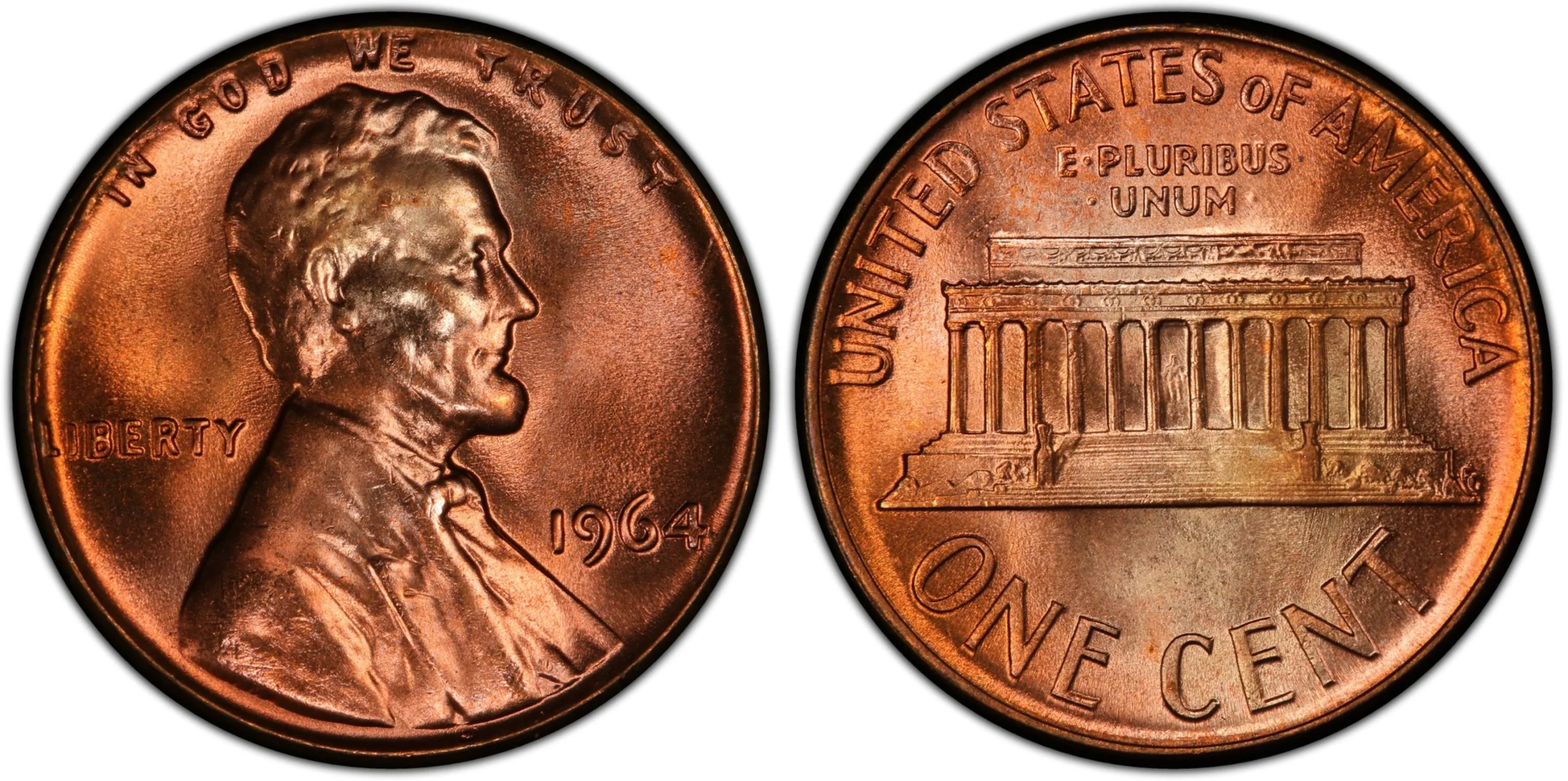
Examine the Surface Color
The coin must flash with the brilliant, original orange-red luster of a fresh mint product. Worn, dull brown surfaces will eliminate any record-breaking price potential.
Inspect Under Heavy Magnification
Use a loupe to verify fields. True auction-quality masterpieces must show nearly clean fields without heavy bag marks, hairline scratches, or scuffs.
Analyze the Rim Structure
Check the outer edges for flat contours. Experimental Special Mint Set pieces feature perfectly square, thick, and sharp rims, while normal business pennies show rounded contours.
Check for Design Doubling
Look closely at the words on the reverse side. The famous FS-801 and FS-802 varieties show crisp, distinct doubled lines under magnification.
Verify the Mint Mark Condition
If your coin features a D mint mark below the date, verify the crispness of the strike. Late-stage die fatigue creates mushy, distorted features that suppress collector bonuses.